Game guide
How to play Pèiduì
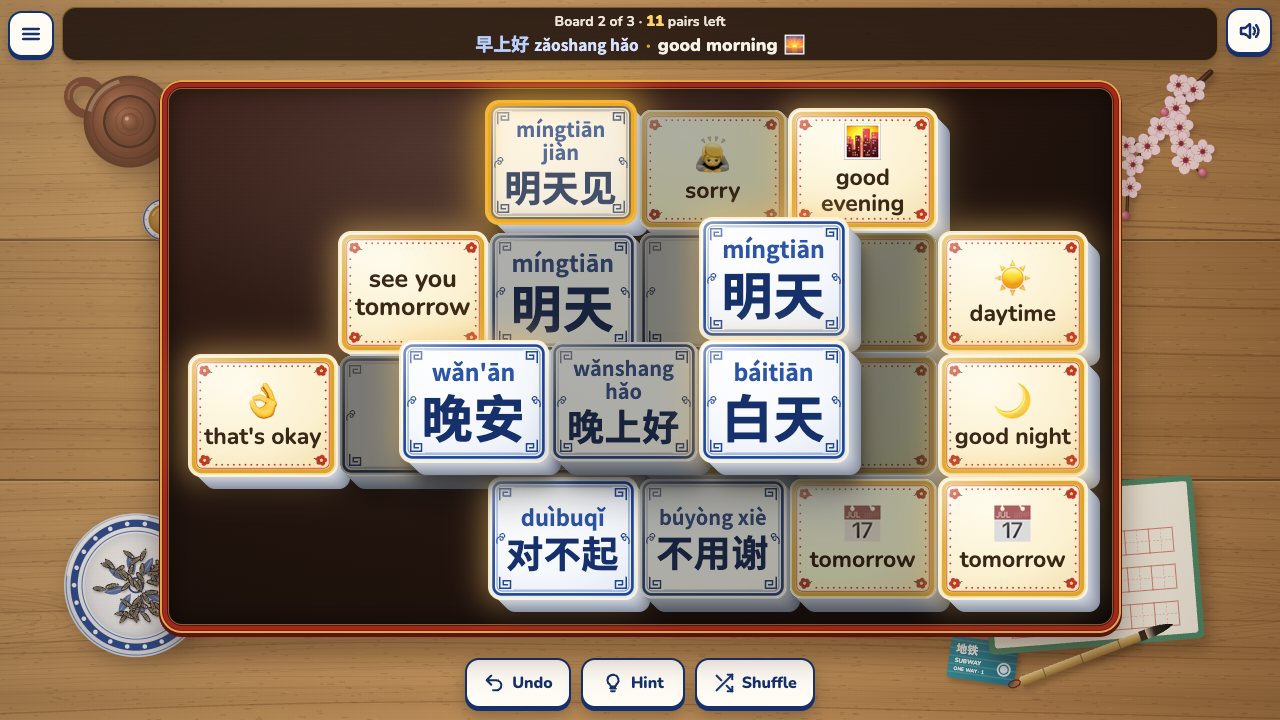
Pèiduì (配对, "pairs") is a free tile-matching puzzle that teaches your first Chinese words: blue-and-white porcelain tiles lie stacked on a lacquer tea tray in a Beijing teahouse, and each pair is a Chinese word, with its pinyin, and its meaning in English. Your goal is to take every tile off the board two at a time, a Chinese word with its meaning, and to clear all three boards of Unit 1 with as many stars as you can.
 Play Pèiduì
- Genre
- Puzzle: tile matching with stacked tiles, where each pair is a Chinese word (with its pinyin) and its meaning, from Unit 1 of our studio's beginner Chinese course (greetings, thank you and sorry, you're welcome, and good morning and good night)
- Players
- 1 player
- Length
- A board takes a minute or two, longer while the words are new to you, and there's no clock. The three boards have 12, 15 and 18 pairs, so all of Unit 1 takes about five to ten minutes the first time. You can replay any board for more stars: the words stay the same, and the tiles lie differently every time.
- Plays on
- Phones, tablets and computers, in a web browser, with no download. Mouse, keyboard or touch, on upright or sideways screens; no gamepad.
- Progress
- Saved in this browser on this device: your best stars on each board, the sound setting, and how many boards you've started and cleared. A board in progress isn't saved, so leaving it or closing the page ends it, and a private window keeps nothing after you close it.
- Price
- Free. No download and no account.
- Version
- 1.0.0
- Feedback
- Comments on itch.io
How to play
- On the start screen, press Play: it starts the first board you haven't cleared yet. The Board 1, Board 2 and Board 3 buttons let you pick any board, and show the stars you've earned on each.
- Every pair is two tiles: a Chinese word on a white porcelain tile with a blue frame, and its meaning in English on a pale yellow tile with red flowers in its corners. Every Chinese tile shows the word's pinyin (how it sounds, with its tone marks) above its characters, so you can read it before you know the characters. A few meaning tiles also show a picture above the words, like a waving hand on the tile for hello.
- You can only take free tiles. A tile is free when nothing is on top of it and its left or right side is open. Free tiles are bright, with a cream rim of light. Blocked tiles sit in the shade with their words still showing, and a tile with another on top is darker still and shows no word until that tile is gone.
- Tap or click a free tile, then its partner. A right pair flies together and pops, and the word, its pinyin and its meaning stay in the status bar at the top until your next match. A Chinese word with the wrong meaning is a miss, and both tiles wobble. Picking a second Chinese word (or a second meaning) just moves your pick to it, and a picked tile pressed again goes back.
- Board 1 has 12 pairs on two layers, Board 2 has 15 pairs on two layers, and Board 3 has 18 pairs on four layers. On Boards 2 and 3, three words are on the board twice, and any of a word's Chinese tiles goes with any of its meaning tiles. The board's shape follows your screen when it starts: wide on a computer or a sideways phone, tall on an upright phone.
- Undo, Hint and Shuffle sit under the board (beside it on a phone held sideways). Undo takes back your last match or shuffle, as far back as you like. Hint lights up a free pair in green. Shuffle mixes the words among the tiles that are left, which stay where they are, into a board you can clear. If no two free tiles go together, No pairs to take offers a shuffle or an undo. There's no clock.
- Clear the board to see a word of praise in Chinese with its pinyin and meaning, your stars, hints and misses, and The words on this board with every word, its pinyin and its meaning. Press Next: board 2 (or 3) to go on, or Play again to play that board again with its tiles in new places. After Board 3, Finish Unit 1 shows your stars on all three boards.
Controls
Keyboard
| Control | What it does |
|---|---|
| ← ↑ → ↓ | Move between the free tiles (blocked ones are skipped); a white ring shows where you are |
| Enter or Space | Pick the tile under the ring, or put it back; then pick its partner the same way |
| H | Hint: light up a free pair |
| U, Z or Backspace | Undo the last match or shuffle |
| S | Shuffle the tiles that are left |
| Escape or P | Open the menu (Back to the board, Start this board again, Back to the title); Escape again goes back to the board |
| M | Sound on or off |
| Tab, then Enter or Space | Move to any button and press it: the start screen's boards, Undo, Hint, Shuffle, and the cards between boards |
Mouse
| Control | What it does |
|---|---|
| Click a free tile, then its partner | Take the pair; click a picked tile again to put it back |
| Point at a tile | A free tile lifts a little under the pointer; a blocked one doesn't |
| Click a blocked tile | See what's in its way: those tiles light up orange, and the status bar says why |
| Undo, Hint and Shuffle (under the board) | Use that help |
| Menu button (top left) | Back to the board, Start this board again, or Back to the title |
| Sound button (top right) | Sound on or off |
Touch (phones and tablets)
| Control | What it does |
|---|---|
| Tap a free tile, then its partner | Take the pair; tap a picked tile again to put it back |
| Tap a blocked tile | See what's in its way: those tiles light up orange, and the status bar says why |
| Tap Undo, Hint or Shuffle | Use that help (under the board, or beside it with your phone held sideways) |
| Tap the menu button (top left) | Back to the board, Start this board again, or Back to the title |
| Tap the sound button (top right) | Sound on or off |
Tips
- Read the shade before you tap. Bright with a cream rim: free. In the shade with its word showing: blocked on both sides, so a tile beside it has to go first. Darker with no word: covered, so the tile on top has to go first. Each layer sits a step up and to the left of the one below and casts a shadow on it. Tapping a blocked tile is never a miss, and a tile that a match sets free glows once as it brightens.
- Use the pinyin. Characters that look alike to a beginner, like 早上好 (zǎoshang hǎo, good morning) and 晚上好 (wǎnshang hǎo, good evening), or 明天 (míngtiān, tomorrow) and 明天见 (míngtiān jiàn, see you tomorrow), are easy to tell apart by their pinyin. Once you've matched a word a few times, try reading its characters before you look up at the pinyin.
- On Board 2 the words on twice are 明天, 明天见 and 白天 (báitiān, daytime), and on Board 3 晚安, 你好 and 早上好. When you can choose which copy of one to take, take the one sitting on top of other tiles, above all one lying on a tile of the opposite kind (a covered tile still shows its blue or yellow frame). Taking tiles never blocks another one, but a word's last two tiles stacked one on the other can never both be free. Board 1 has every word once, so there any pair you can take is a safe move.
- Undo and Shuffle never cost a star: only hints and misses count. If No pairs to take appears, or you've left a word's last two tiles stacked, they get you out: Undo goes back to before the mistake, and Shuffle, when the tiles left allow it, deals the words that are left onto the same tiles in a way you can clear. An undo doesn't take back a miss.
- Three stars take no hints and at most two misses. Two stars allow up to two hints and six misses, and anything more is one star. Every press of Hint counts. Your best stars on each board are kept, and the board buttons on the start screen show them.
- Read the brackets and the little words. 您 (nín) is you (polite), the you for a teacher or an older person. 不 (bù) means not, no, and it starts 不客气 (bú kèqi, you're welcome), 不用谢 (búyòng xiè, don't mention it) and 不好意思 (bù hǎoyìsi, excuse me): its tone changes before a fourth tone, and the pinyin shows it.
Screenshots


More games
-
 Tiánzì
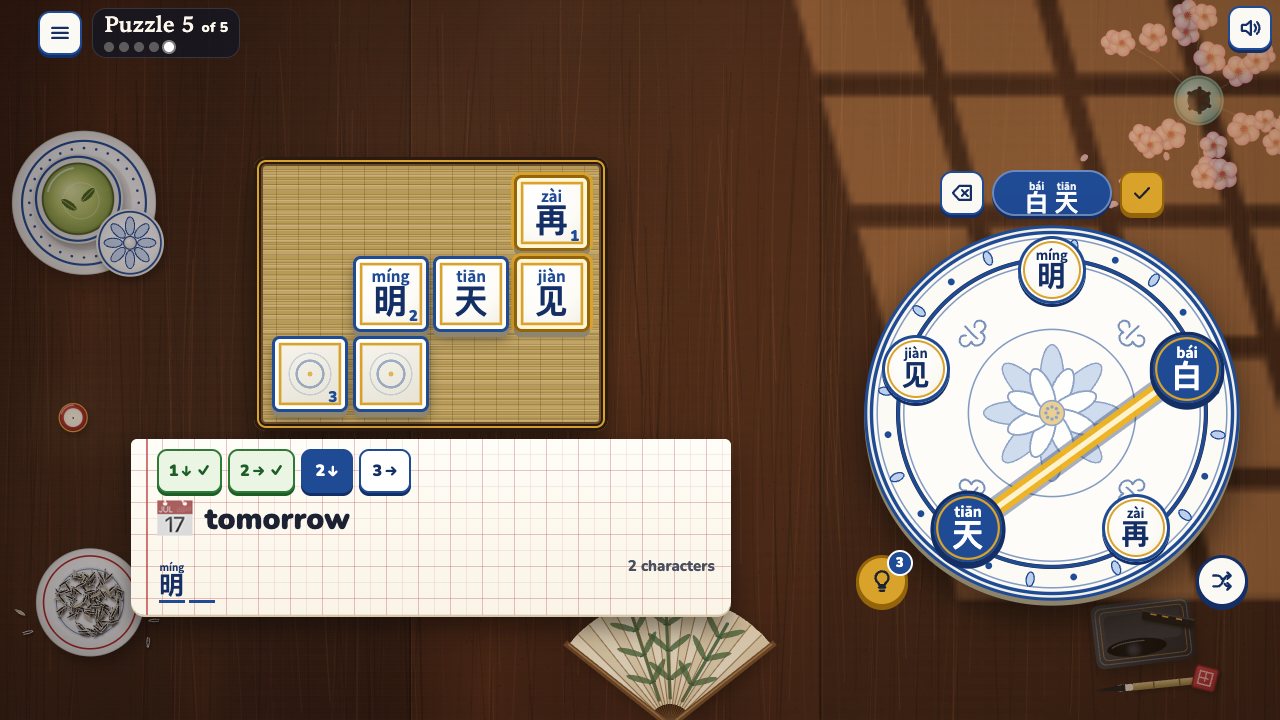
A word-wheel crossword in Chinese. Swipe the characters, pinyin on every one.
How to play Tiánzì -
 A Day in Beijing
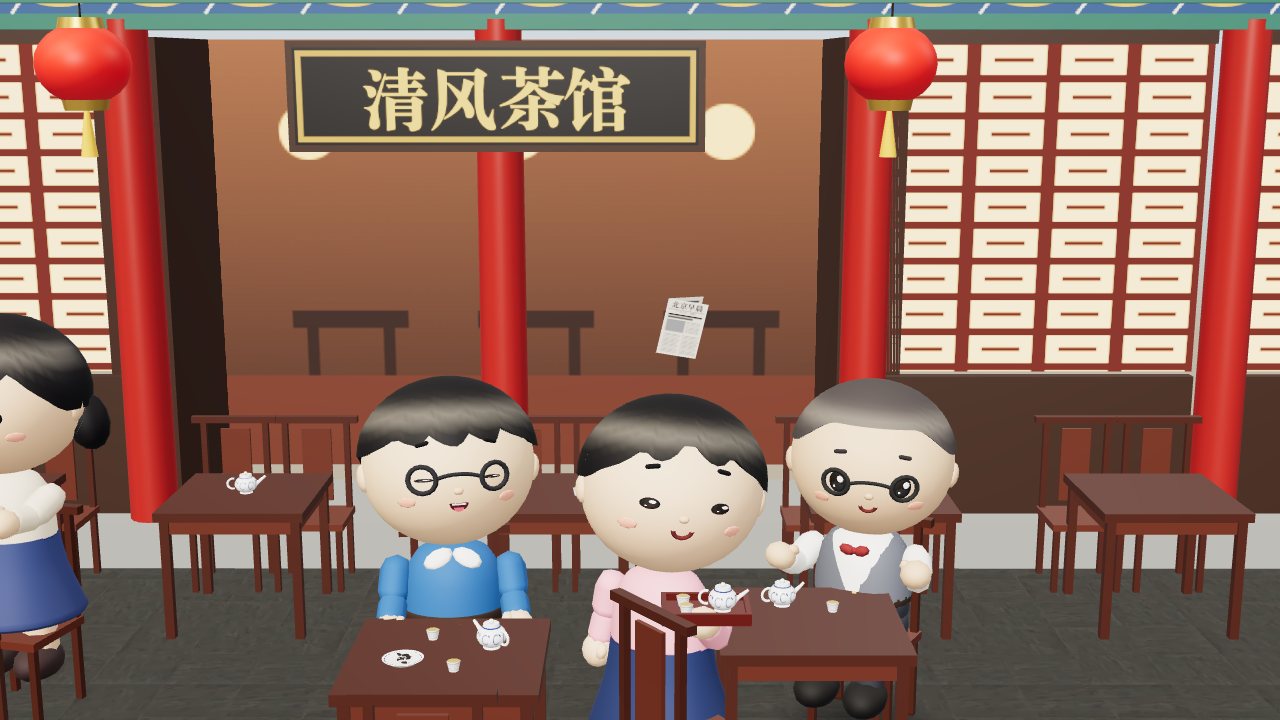
Your first day in Beijing, and your first Mandarin, with pinyin over every word.
How to play A Day in Beijing -
 Pares
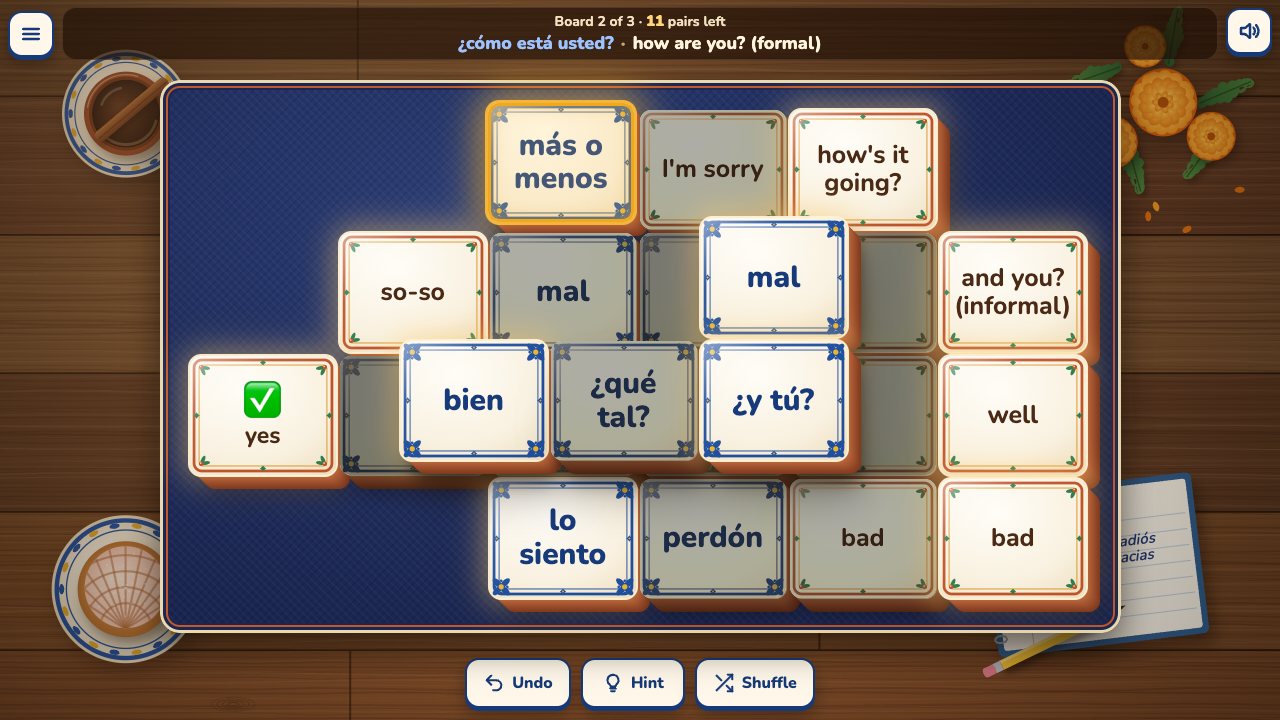
Spanish word pairs on Talavera tiles. Match each Spanish word to its meaning to clear the board.
How to play Pares -
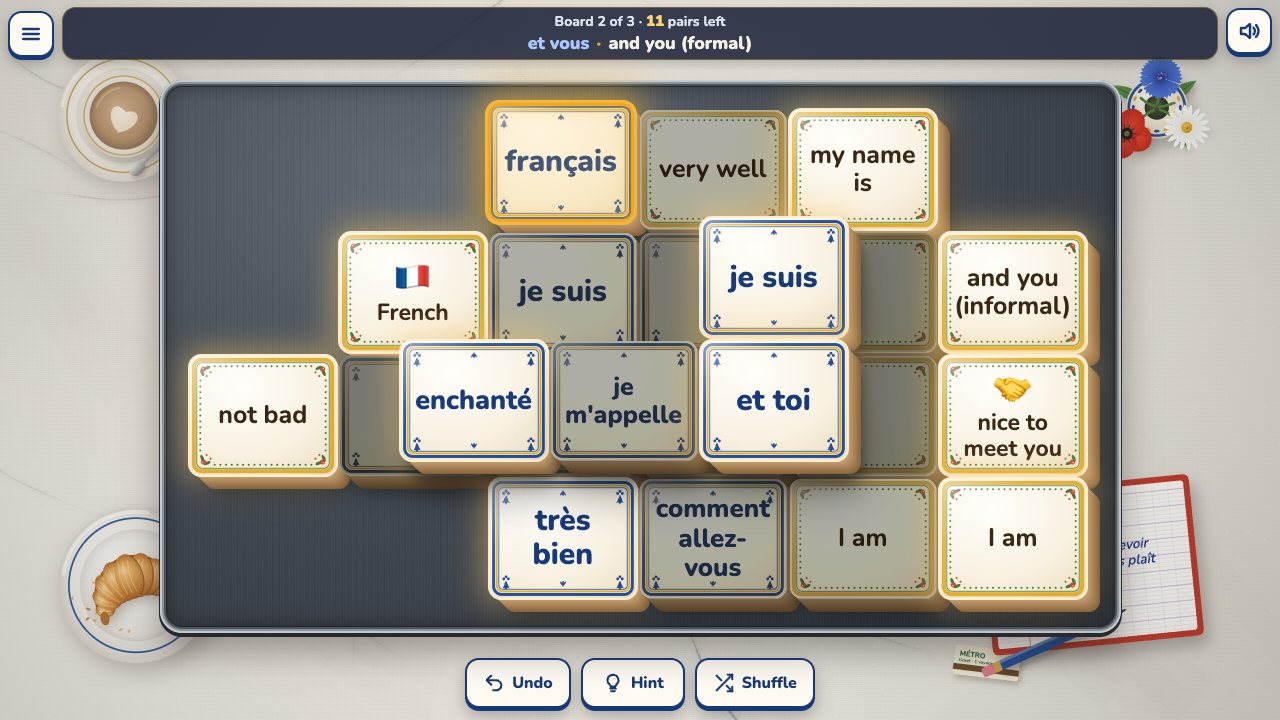 Paires
French word pairs on faience tiles at a Paris café. Match each French word to its meaning to clear the board.
How to play Paires -
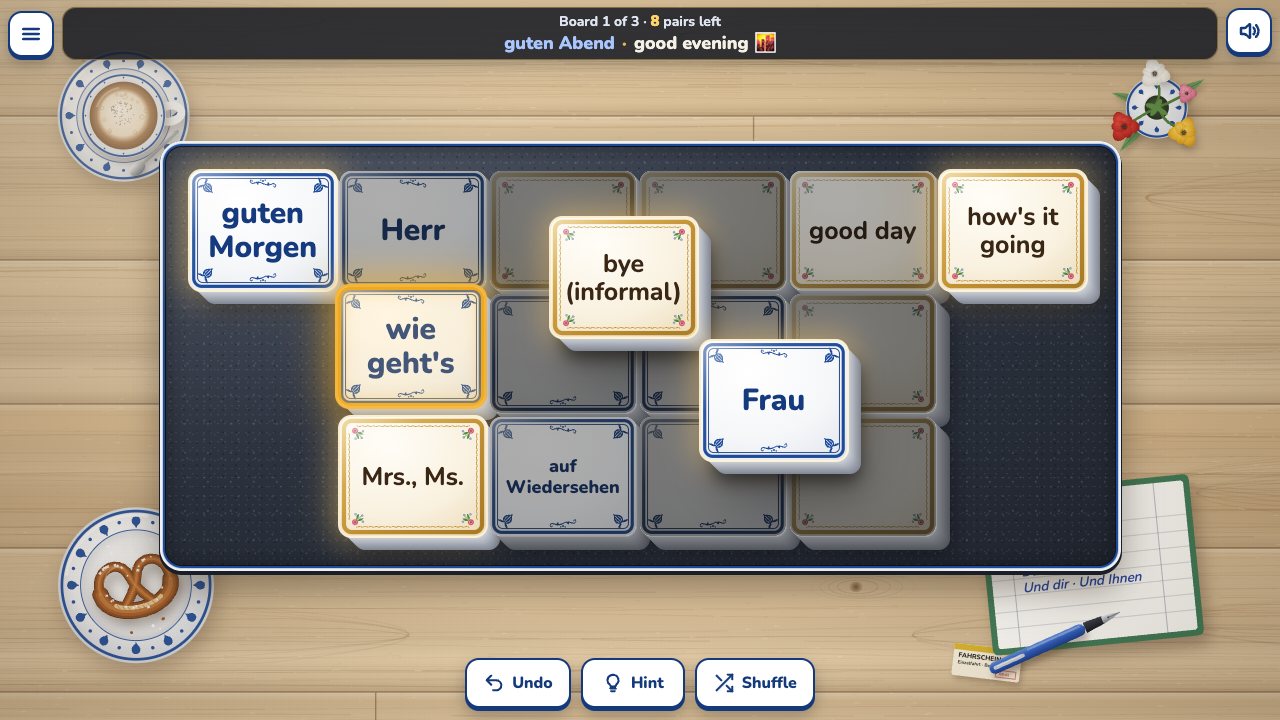 Paare
German word pairs on blue-and-white porcelain tiles at a Berlin café. Match each German word to its meaning to clear the board.
How to play Paare