Game guide
How to play A Day in Paris
A Day in Paris is a free 3D story game about your first day in Paris, from the Gare de Lyon at 8:05 in the morning to bedtime in your friend Léa's flat under the roofs, where you talk your way through the day in beginner French with the meanings in English. Your goal is to get through the day's 15 replies, collect a stamp in your travel journal in each of its six places and meet all 21 phrases of the first unit of our studio's beginner French course: hello and goodbye, how are you, please and thank you, tu and vous, and introducing yourself.
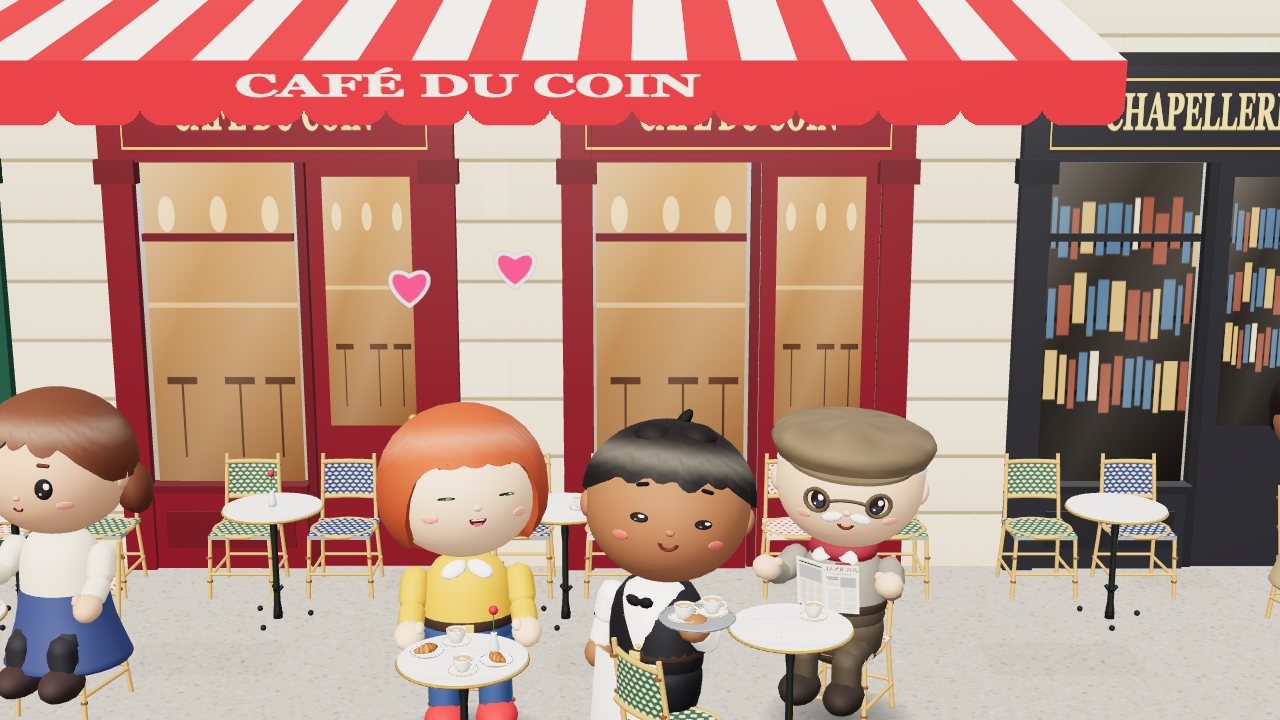 Play A Day in Paris
- Genre
- Story game with choices, in 3D, that teaches beginner French from the first unit of our studio's beginner French course
- Players
- 1 player
- Length
- One episode of 80 short beats across six places, 15 of them replies and two of them things to do. It takes roughly 7 to 9 minutes, longer if you open every Why? note and the phrasebook. There's no clock, and you can stop at any line and carry on later.
- Plays on
- Phones, tablets and computers, in an up-to-date web browser with WebGL, with no download. Tap, click or use the keyboard, on upright or sideways screens; no gamepad.
- Progress
- Saved in this browser on this device after every step: the sound setting, your place in the episode (the line you're on, the phrases you've met and said, your journal's stamps, second tries and hearts, and any replies crossed out on the question you're on), and how many episodes you've started and finished. Finishing the episode clears your place, so Play again starts at the station. A private window may not keep anything.
- Price
- Free. No download and no account.
- Version
- 1.0.0, updated October 12, 2026
How to play
- On the title screen, press Play, then Start on the episode's card (Episode 1, Your first day). You play Claire, from Lyon. If you left the story part-way, the title offers Continue, which takes you straight back to the line you were on, and Start again, which begins a fresh run from the station once you press Start.
- The day moves through six places: the Gare de Lyon, where Léa waits on the platform with a welcome sign, the Métro, where an elegant lady sits with a basket of leeks, Madame Martin's boulangerie, the terrace of the Café du Coin with Yanis the waiter and Monsieur Bernard, a street in Montmartre at dusk with a mime and Sylvie's flower shop, and Léa's building and her flat at the top of it. The time and the place show in the top left corner.
- Each line appears in the box at the bottom of the screen: who's speaking, their French, and its meaning in English underneath. A few lines show a picture instead, like a croissant for Un croissant? Tap or click the scene, the box or Continue, or press Enter or Space, to carry on. If the line is still typing out, the first press shows all of it.
- Fifteen times it's your turn, in a box headed Your reply that repeats the line you're answering. Every reply is in French: some ask you to pick the right phrase, some to answer what someone has just said, some to tap French words in order to build a sentence, and some to fill in a missing word. Tap or click your answer, or on a computer press the number shown on it.
- A right reply shows your line in French with its meaning, the person you answered hops with hearts over their head, and any new phrases go into your phrasebook. A wrong reply costs nothing: the person reacts, your choice is crossed out, and a note headed Not quite shows what your choice meant and gives a hint, with a Why? button for the full grammar note. Then you try again.
- Twice the story needs a hand rather than words: a button to catch Monsieur Bernard's newspaper when the wind snatches it at the café, and one to help the mime out of his invisible box in Montmartre. Press it, tap or click the scene, or press Enter.
- At the end of each place a stamp lands in your travel journal. The day ends at Léa's, with you asleep on the sofa bed and Minou, the neighbour's cat, on your feet. The end screen shows your journal, the phrases you met out of 21, your stamps, your second tries and the hearts each person gave you, with buttons for the Phrasebook, Play again and the Title.
Controls
Keyboard
| Control | What it does |
|---|---|
| Enter or Space | Carry on to the next line (the first press shows a line that's still typing out), or do the thing the story asks for. When a button has focus, it presses that button instead |
| 1 to 9 | Pick the reply with that number, or place the word with that number in a word bank (the numbers show on the buttons) |
| Backspace | Take back the last word you placed in a word bank |
| Type in the box, then Enter | Fill in a missing word. The box has the focus when the question opens; accents and capitals are optional. While you type, number keys and letters go into the box, so B, M and P don't work as shortcuts there |
| B | Open or close the phrasebook |
| P or Escape | Pause or resume. With the phrasebook open, close it |
| M | Sound on or off |
| Tab, then Enter or Space | Move to any button and press it: replies, words, Why?, the corner buttons and every menu |
Mouse
| Control | What it does |
|---|---|
| Click the scene, the dialogue box or Continue | Carry on to the next line; a click while a line is typing out shows all of it |
| Click a reply | Answer with it. A reply that's crossed out can't be picked again |
| Click words in order | Build a sentence in a word bank. It checks itself once you've placed as many words as the answer has; Check checks it sooner, and Undo or a click on a placed word takes one back |
| Click a word under the sentence, or type it in the box | Fill in the blank (press Enter after typing) |
| Click Why? | Show the full grammar note behind a hint |
| Click the button or the scene, when there's something to do | Catch the newspaper, or help the mime out |
| Click the book, pause or sound button (top right) | Open the phrasebook (its number is how many phrases you've met), pause the story, or turn the sound on or off. In the phrasebook, Phrases and Journal switch pages, and × or a click outside it closes it |
Touch (phones and tablets)
| Control | What it does |
|---|---|
| Tap the scene, the dialogue box or Continue | Carry on to the next line; a tap while a line is typing out shows all of it |
| Tap a reply | Answer with it |
| Tap words in order | Build a sentence in a word bank; tap a placed word or Undo to take one back |
| Tap a word under the sentence | Fill in the blank (on a touch screen you pick the word rather than type it) |
| Tap the button or the scene, when there's something to do | Catch the newspaper, or help the mime out |
| Tap the book, pause or sound button (top right) | Open the phrasebook, pause the story, or turn the sound on or off |
Tips
- Check the clock in the top left before you greet anyone, because French greets by the time of day. Bonjour works from the morning until about six in the evening (in the Métro and at the boulangerie; pick bonsoir at 8:05 and Léa points at the station clock), then it's bonsoir (at Sylvie's flower shop at seven, on Léa's stairs and at dinner). Bonne nuit isn't a greeting at all: it's what you say to someone going to bed, which is why Léa says it to you at the very end.
- French has two ways to say you, and the rest of the sentence follows the choice. Léa and Yanis are friends, so between them it's salut, ça va and et toi. The lady in the Métro, Madame Martin and Monsieur Bernard are strangers, so with them it's bonjour, madame, comment allez-vous, et vous and s'il vous plaît. Salut is for friends only: try it on Madame Martin and her face tells you so.
- A wrong reply costs nothing but another try, so read the hint and the Why? note rather than guessing. Stamps and hearts can't be lost: every place gives its stamp, and every right reply, first try or not, wins a heart from the person you answered. The number that changes is second tries on the end screen, so a run with none is the thing to aim for.
- On a computer, a missing word comes with a typing box that already has the focus, so you can type straight away and press Enter. Accents and capitals are optional (ca counts for Ça), and your line then shows the word spelled correctly. If you'd rather pick the word, click it under the sentence: while the box has the focus, a number key types a number into it.
- The phrasebook (B, or the book button) lists all 21 phrases of the unit in its three lessons: hello and goodbye, asking how someone is, and introducing yourself. The ones you've met show their meaning, most with a short note, and You said it marks the ones you used in a reply yourself rather than only heard. The Journal tab shows the stamps you've collected so far.
- The story saves after every line and reply. Switching to another tab or app pauses it, Back to the title in the pause menu keeps your place, and Continue on the title picks up at the same line, even after you close the browser. Start the episode again in the pause menu, or Start again on the title, begins a fresh run from the station.
Screenshots


Recent updates
Version 1.0.0 · October 12, 2026
The first release of A Day in Paris, a little 3D story game where you talk your way through your first day in French.
- Episode 1, "Bonjour ! First Words": step off the train at the Gare de Lyon, where your friend Léa is waiting with a sign, meet an elegant lady (and her flying hat) in the Métro, buy a croissant at the boulangerie, catch Monsieur Bernard's newspaper on a café terrace, free a mime from his invisible box in Montmartre at dusk, and finish with dinner at Léa's.
- Every reply comes from Unit 1 of our studio's beginner French course: hello and goodbye, how are you, please and thank you, tu and vous, and introducing yourself.
- Every French line comes with its meaning in English (or a picture), and a reply that isn't right just gets a kind correction and another try.
- The phrasebook keeps the phrases you've met, and your travel journal collects a stamp for each place.
- No music: just the sounds of each place and of the story, all made in code. Works on phones and computers, with a keyboard, a mouse or touch.
More games
-
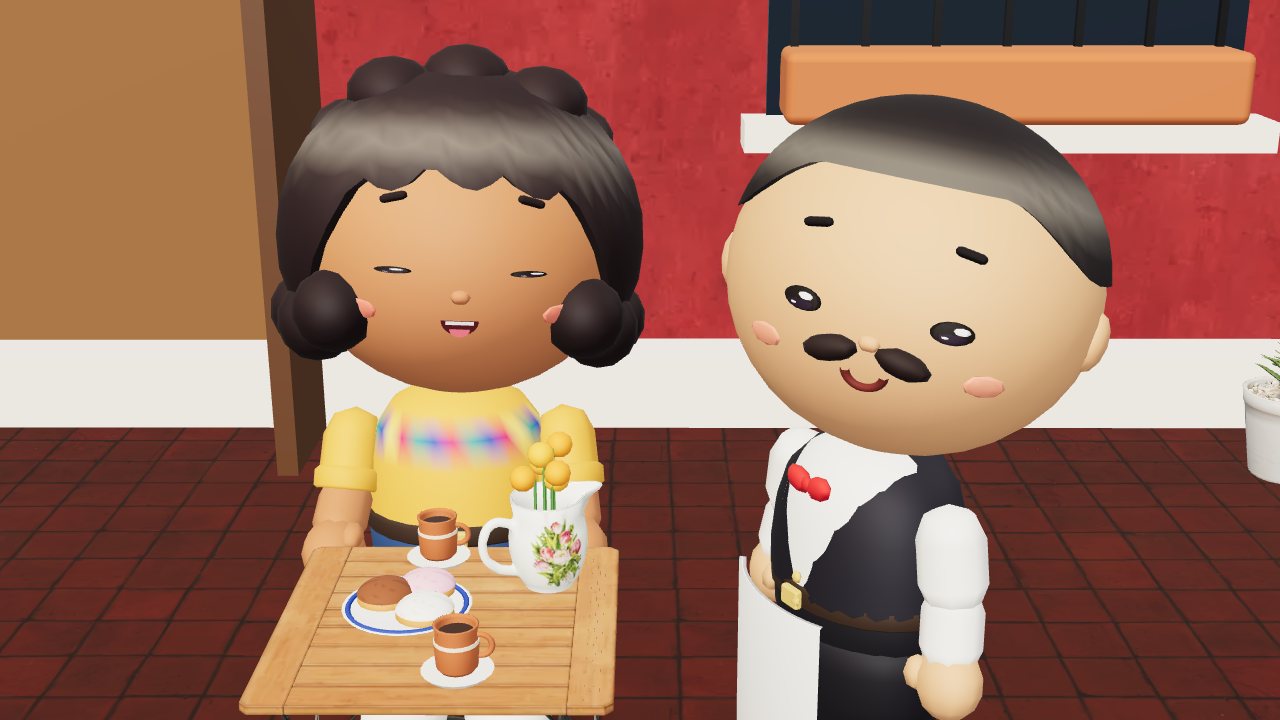 A Day in Mexico City
Your first day in Mexico City, and your first Spanish. Every reply is real Spanish from a beginner course.
How to play A Day in Mexico City -
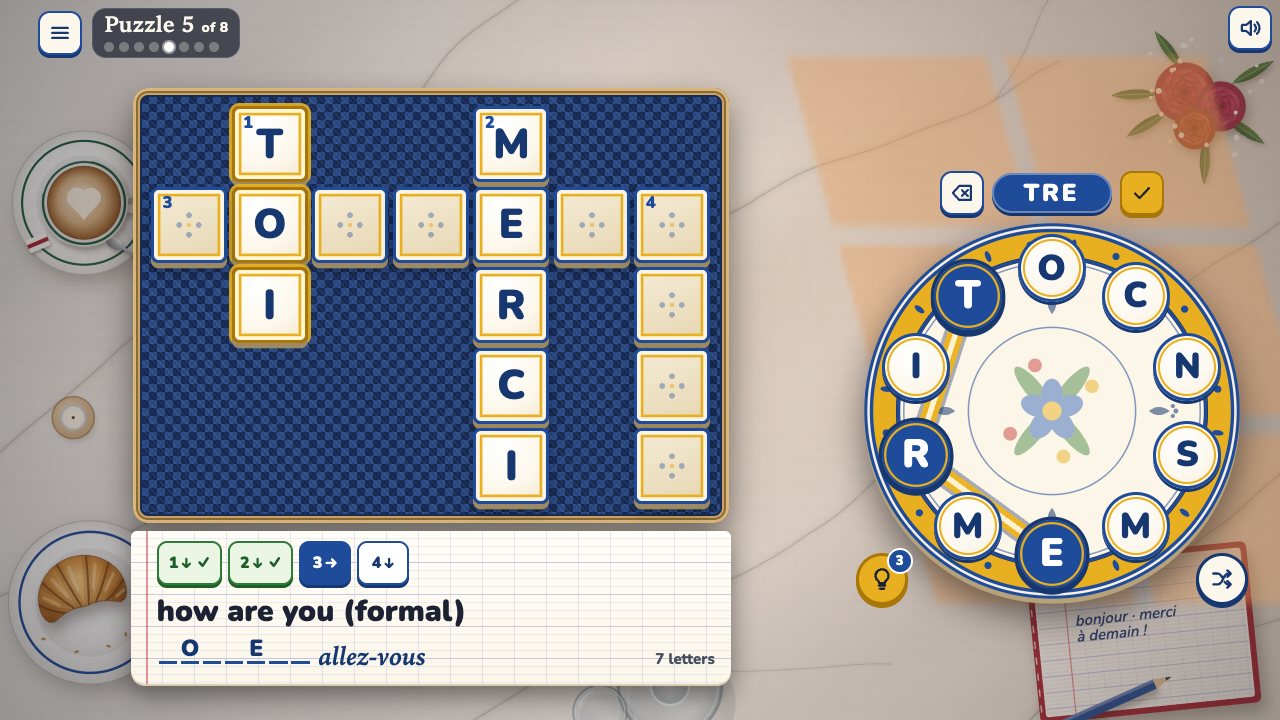 Mots
Mots
A word-wheel crossword in French. Swipe the letters, clued in English.
How to play Mots -
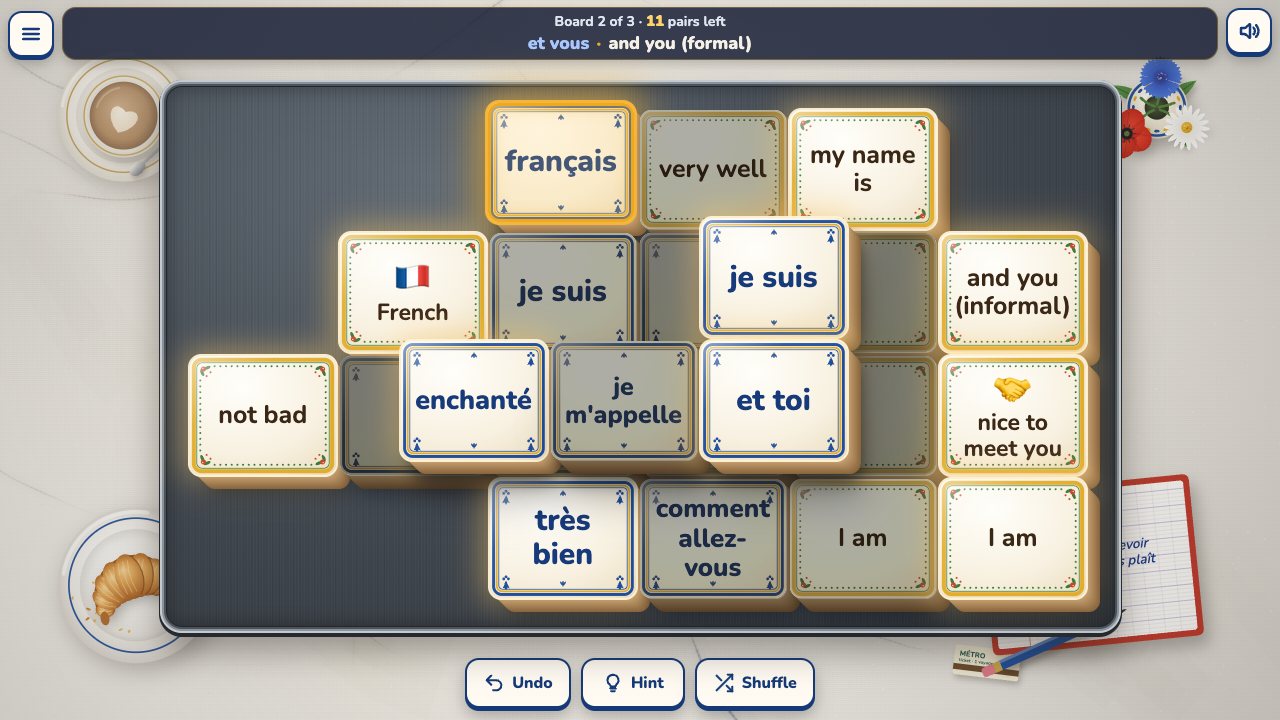 Paires
French word pairs on faience tiles at a Paris café. Match each French word to its meaning to clear the board.
How to play Paires -
 Hit Your Dot
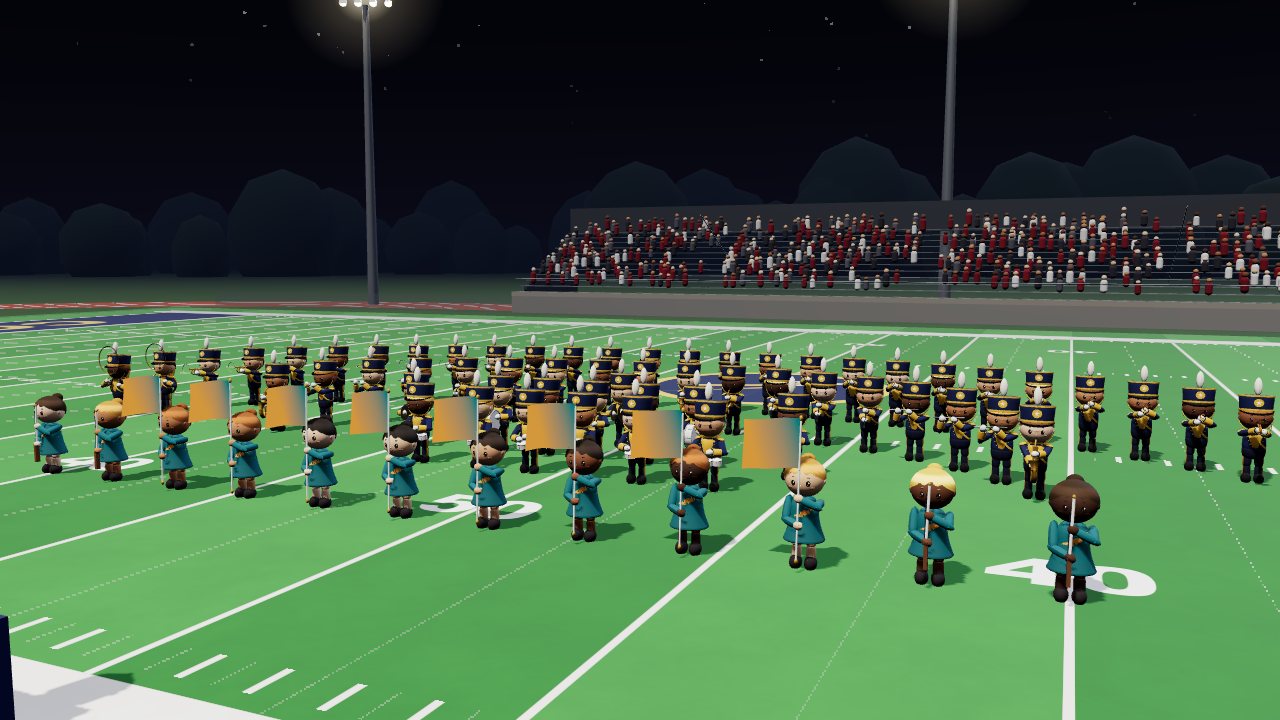
One marching band season: band camp, Friday nights, contests. March your drill and hit your dot.
How to play Hit Your Dot